
Drain Repairs in Stockport — Collapsed Drains & Root Ingress
When a drain has gone beyond lining, it needs digging — properly, once, and put back the way it was found. Collapsed sections, root damage, failed connections and broken chambers.
Get a second opinion before anyone brings a digger.
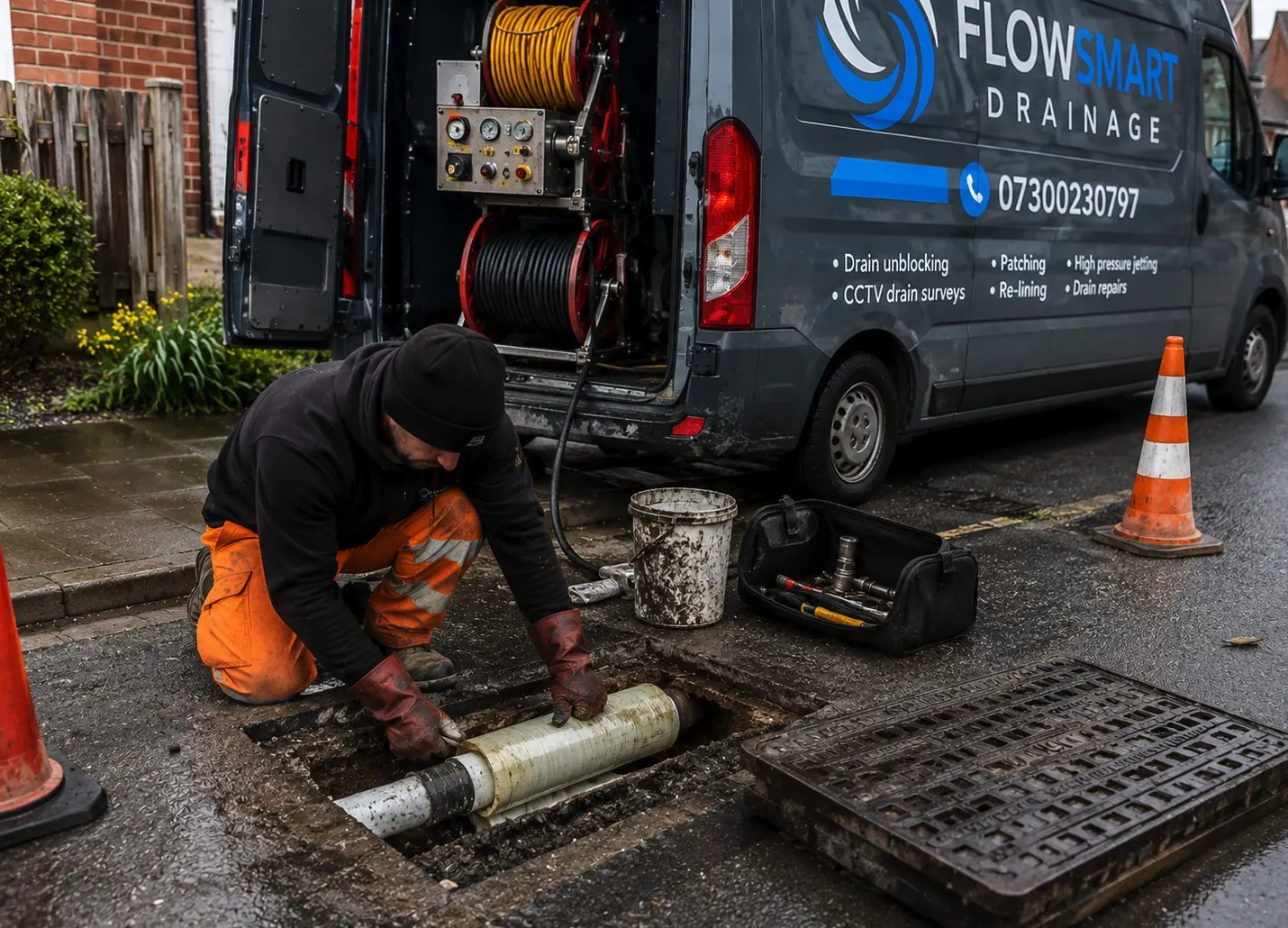
What we repair
- Collapsed drains — where the pipe has lost its shape entirely and there is nothing left to line.
- Root ingress — cutting the roots out, then either lining the entry point or replacing the section, depending on what the pipe underneath is worth.
- Cracked and fractured pipe — clay is brittle, ground moves, and a hundred years is a long time.
- Displaced and open joints — the classic Victorian and inter-war failure, and the classic way roots get in.
- Failed or illegal connections — extensions plumbed into the wrong pipe, or a joint that was never made properly.
- Broken chambers and gullies — often the cheapest thing on this list and the one most often ignored.
- Soil stacks and vent pipes — the vertical pipe up the outside of the house is a different job from the drain under it: see soil pipe repairs and replacement.
If one of these has turned up on a house you are buying rather than one you already own, the useful question comes before the repair: whose pipe is it. A defect beyond your boundary or on a shared run is very often not the buyer’s to fix at all — see homebuyer drain surveys for how that gets answered before you exchange.
Manhole and chamber repairs
Chambers give warning before they fail: a cover that rocks, brickwork gone soft at a corner, a smell in warm weather. Pipes rarely do.
- Cracked, sunken or rocking covers. Usually the frame and its mortar bed rather than the chamber underneath — a smaller job than it looks.
- The wrong cover for the load. An A15 lid is rated for pedestrians and cracks the first time a van parks on it. Drives want B125, roads D400.
- Recessed covers for block paving. A tray filled with your own blocks, so the paving runs over the chamber instead of stopping at a steel lid.
- Worn channel and benching. The half-round invert in the base and the sloped concrete either side that keeps flow in it. Once either erodes, waste sits in the chamber instead of running through. That is usually the smell.
- Failed brickwork. Victorian and early inter-war chambers are often soft brick and lime mortar, and a century of foul water takes them. Rebuilt in brick, or replaced in plastic where the depth allows.
- No access at all. Some runs have none, which makes every future job on them dearer.
Drain lining and CCTV surveys go in through a chamber you already have. With no access, the no-dig options are off the table and the only route left is a trench — so putting a chamber in pays for itself the first time that drain needs a camera or a liner.
How an excavation repair runs
- 1
Locate precisely
The camera and sonde mark the defect on the surface to within a few centimetres, so we open up one section rather than searching with a spade.
- 2
Agree the price before anything is dug
Including reinstatement. Reinstatement is often the largest part of an excavation bill and it should never be an afterthought on the invoice.
- 3
Excavate and replace
The failed section comes out and is replaced with new pipe, properly bedded and connected to the sound pipe either side.
- 4
Test, backfill, reinstate
The repair is checked on camera before anything is covered up, then backfilled and the surface put back — block paving relaid, turf replaced, tarmac made good.
Not sure whether you need a repair or a clean?
Send us the footage from another survey, or just tell us what it is doing. We will give you a straight answer.
Common questions
How do I know if my drain has collapsed?
The usual signs are repeated blockages in the same place, slow drainage that never fully clears, a damp or sunken patch of ground along the drain run, and sometimes a smell. The only way to know for certain is to put a camera down.
Will you have to dig up my driveway?
Only if the repair genuinely cannot be done from the inside, and only over the failed section — not the whole run. We locate the defect precisely first so that the hole is as small as it can be.
Who is responsible for a collapsed drain?
If the pipe only serves your property and is within your boundary, it is yours. Shared drains and sewers beyond the boundary generally transferred to the water company in 2011. We will tell you which side of that line your defect falls on before you spend anything.
Do you put the surface back?
Yes, and the price you agree includes it. Block paving is lifted and relaid, turf replaced, tarmac made good. Tell us up front if the surface is something specialist — decorative resin and stamped concrete in particular — and we will be straight with you about what we can and cannot match before any of it comes up.
My manhole cover is cracked and rocks when I stand on it. Does the whole chamber need replacing?
Usually not. It is nearly always the frame and its mortar bed, which comes out and is re-set without touching the brickwork. Check the rating while it is open: a cover made for a footpath will crack again on a drive, so swapping like for like buys the same problem back. We will tell you which you have before quoting.
Can I have a cover that matches my block paving?
Yes. A recessed tray cover is filled with the blocks lifted from around it, so the paving runs over the chamber and all you see is the frame outline. It costs more than a plain steel lid. The tray still has to carry whatever parks on it, so it needs the same load rating a solid cover would.
What to read next
No-Dig Drain Relining
A cracked or broken drain does not have to mean a digger on your driveway. Most can be repaired from the inside, in a day, through an existing access point — for a fraction of the cost of digging.
Read moreCCTV Drain Surveys
A camera down the drain, full colour footage, and a written report you can actually act on. Usually within the week — and if there is nothing wrong, we will tell you that too.
Read moreSoil Pipe Replacement
Cracked cast iron, a stack that smells, or a joint that has been staining the same patch of wall for years. Most soil pipes want one section putting right rather than the whole run replacing — and you will hear which before anyone quotes.
Read moreSurface Water Drainage
Water standing on the drive, or running towards the house instead of away from it. Nearly always the fall, the soakaway or a gully that has been paved over — and it is worth finding out which before anyone lifts a slab.
Read moreWhere we do this
Drain Repairs across Stockport and the towns around it. Pick your town for response times, postcodes and the drainage we actually see there.